A Practical Guide to Writing a Good Dissertation - Part I
The Research Question and Finding the Research Gap
UCL Centre for Advanced Spatial Analysis
2026-05-19
The Research Process
Question
Review
Methods
Discussion
The Research Question

What is a Research Question?
- The central question your piece of research is trying to answer.
- It motivates your research — it is the reason you are doing it.
- It guides every decision you make: what to read, what to measure, what to argue.
- Without it, your reader is left wondering: Why are they doing all of this?
What Makes a Good Research Question?
- Clear — provides all the context needed for the target audience to understand it
- Focused — the right scope for the time you have
- Concise — uses as few words as necessary
- Novel — has not yet been (sufficiently) answered
- Objective — avoids value judgements like “good” or “bad”
Good vs. Bad Research Questions
Too vague:
What changes can we see in urban residents over the past decade?
Better:
How have UK cities changed between the 2011 and 2021 census in terms of the age, language, health, work, income, and family status of urban residents?
Too vague:
What effect have anti-climate change innovations had?
Better:
What effect have UK government green grants had on the number of heat pump installations and installer certifications between 2008 and 2022?
Finding Your Research Question
A Step-by-Step Process
- Define your research topic
- Identify a specific problem your field needs to address
- Find the research gap
- Formulate the research question
Step 1: Define Your Research Topic
- You already have a broad topic from your Masters project.
- Now you need to narrow it down. Consider:
- Category — a specific sociodemographic group?
- Time — a specific period?
- Location — a specific city or region?
- Issue — a specific perspective or concern?
Step 2: Identify a Problem
- Think of a specific, real-world problem your field needs to address.
- Ask: What is broken, missing, or poorly understood in this space?
- Examples from urban transport:
- Violence against women and girls in public transport.
- Mismatch between public transport supply and demand at night.
- Unequal accessibility to job opportunities by bus.
- Finding suitable locations for car parks.
Step 3: Find the Research Gap
- A research gap is what is unknown or unresolved about your problem in the academic literature.
- To find it, you need to read what others have done — this is the literature review.
- You are looking for:
- What has been studied extensively?
- What has been overlooked or understudied?
- What methods have been used — and which haven’t?
- The gap is where your research lives.
Step 4: Formulate the Question
Topic → Urban green space and health
Problem → Cities are getting hotter, but green space is distributed unequally across neighbourhoods
Gap → Studies link greenery to cooling effects at city scale, but few examine whether low-income areas benefit equally
To what extent does proximity to urban green space reduce heat-related hospital admissions across London neighbourhoods, and does this relationship vary by deprivation level?
Objective Clear & Concise Focused Novel
A Note Before the Literature Review
- Your research question will almost certainly change as you read more.
- This is normal and expected — treat the first version as a working hypothesis.
- The literature review is what allows you to sharpen it.
The Literature Review
What is a Literature Review?
- The section of your dissertation where you describe the development of your research area to provide a foundation for your own research.
- A good literature review does not just describe what others have done.
- It critically addresses other approaches and explains how your research fills the gaps left by previous studies.
How to Structure It
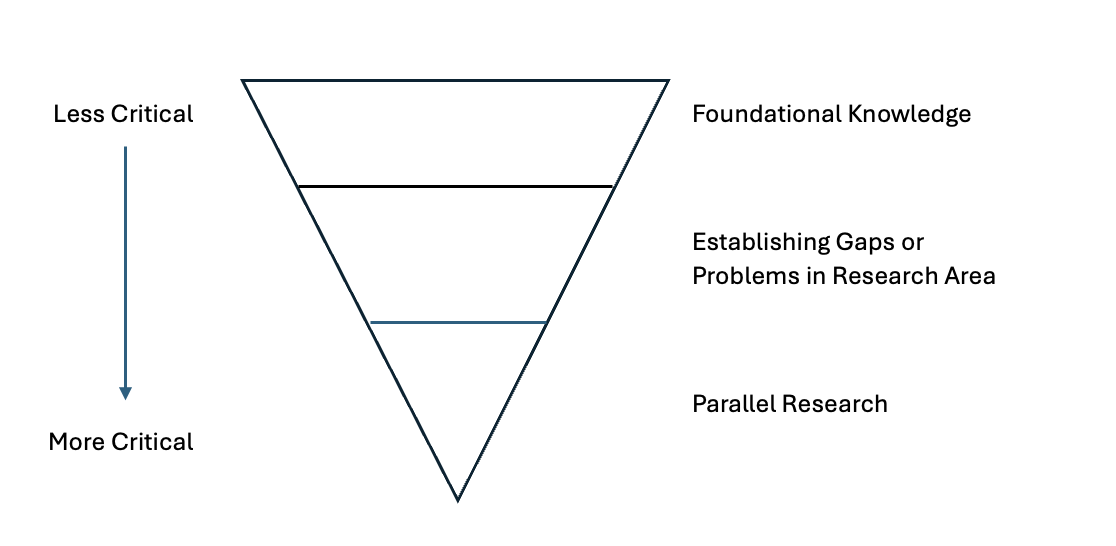
How to Structure It
1. Foundational knowledge — established, uncontroversial facts about your topic
Post-industrial human activity has contributed to global warming.
2. Establishing the gap — what remains unknown, underexplored, or methodologically limited
3. Parallel research — recent attempts to address the gap; critical appraisal of methods and data
4. Your contribution — how your research fills the gap and why your approach is novel
Listing vs. Reviewing
Just listing:
“Gonzalez et al. (2018) found that urban trees reduce surface temperatures. Li et al. (2020) showed no significant effect of park size on air temperature. Wang et al. (2016) linked green roofs to reduced heat island intensity.”
Critical review:
“While early studies established a link between urban vegetation and surface cooling (Gonzalez et al. 2018; Wang et al. 2016), findings remain inconsistent across spatial scales. Li et al. (2020) found no significant effect of park size on air temperature, suggesting that the benefits of green infrastructure may be highly context-dependent. Crucially, none of these studies examine whether cooling effects are equitably distributed across socioeconomic groups — the gap this research addresses.”
Finding Literature
Three Rules for Writing It
Don’t list — argue. Every paper should earn its place by advancing your narrative.
Build a story from general to specific, ending at your research gap.
Show the gaps, tensions, and contradictions in the literature — that is where your research lives.
Key Takeaways
Research question
- Clear, focused, concise, novel, and objective
- Narrow your topic → identify a problem → find the gap → formulate
Literature review
- A critical argument, not a list
- Funnel from foundational knowledge → gap → your contribution
Next steps
- Draft a working research question before our next meeting
- Start reading and keep a literature review table/notebook/whatever works for you!